

Project Location • 7 min read
Sector 36: The Address Taking Shape
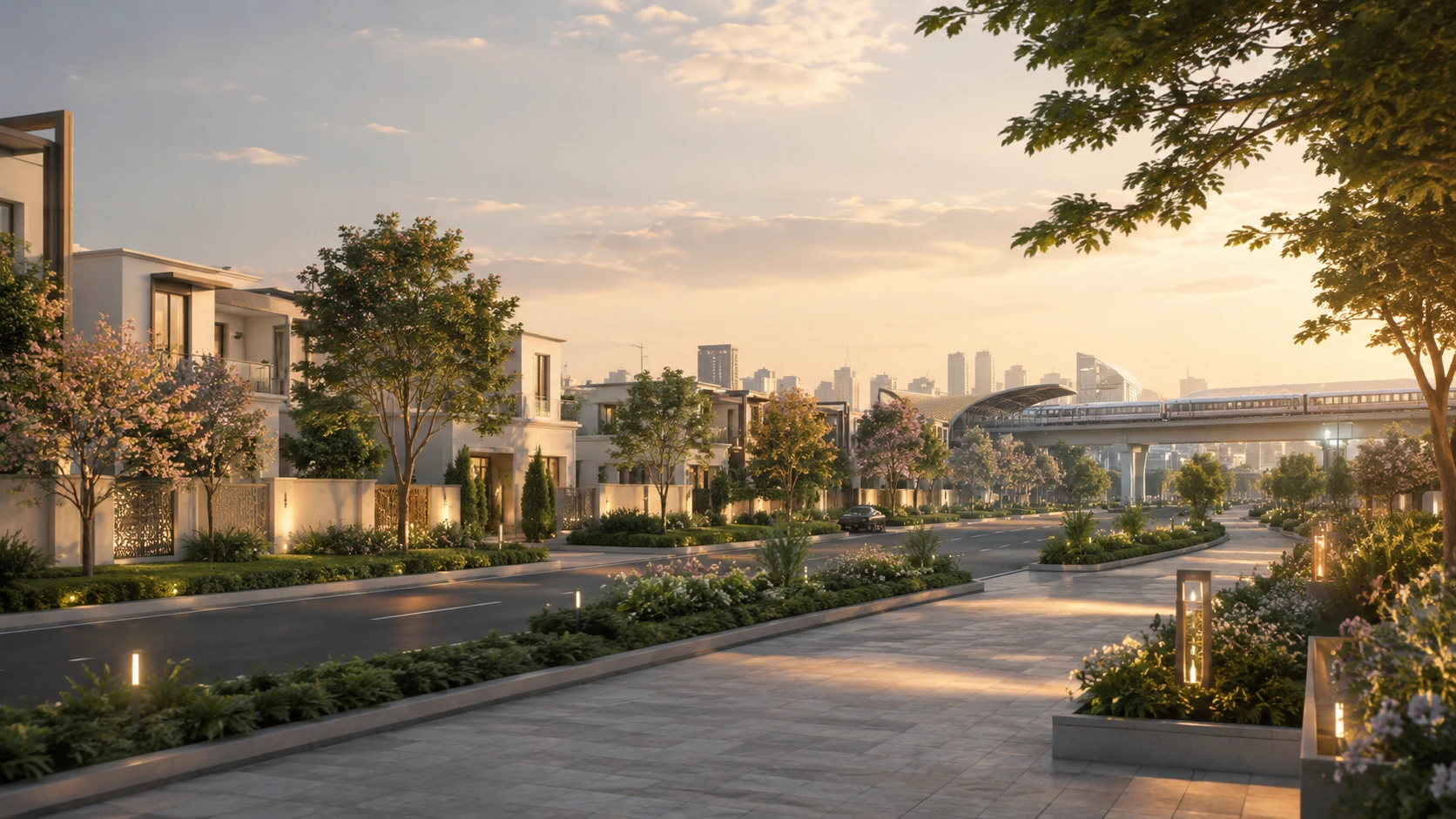
Positioned near key civic, rail and emerging road infrastructure, Sector 36 offers buyers a location story shaped by connectivity, planning and long-term regional growth.
A planned residential address within a district entering its next phase
The strongest location stories are rarely created by a single road, project or announcement. They take shape gradually, through planning, employment, civic infrastructure and the steady expansion of a city around them.
Sector 36 in Jhajjar is at precisely that stage.
It is not a finished urban neighbourhood, nor should it be presented as one. What it offers is something more fundamental: an officially planned residential setting positioned close to Jhajjar’s existing civic centre, supported by operational railway and highway access, and aligned with a wider regional growth story driven by industry and infrastructure.
For future homeowners, this creates an opportunity to consider organised plotted living near an established district city. For long-term investors, it creates a case built around planned land use, an expanding employment catchment and infrastructure that may improve the sector’s accessibility over time.
The opportunity is therefore not based on an overnight transformation. It lies in entering an address while its wider urban ecosystem is still taking shape.
Planning comes first
A project can create infrastructure within its own boundary. A sector plan determines how that project fits into the future city around it.
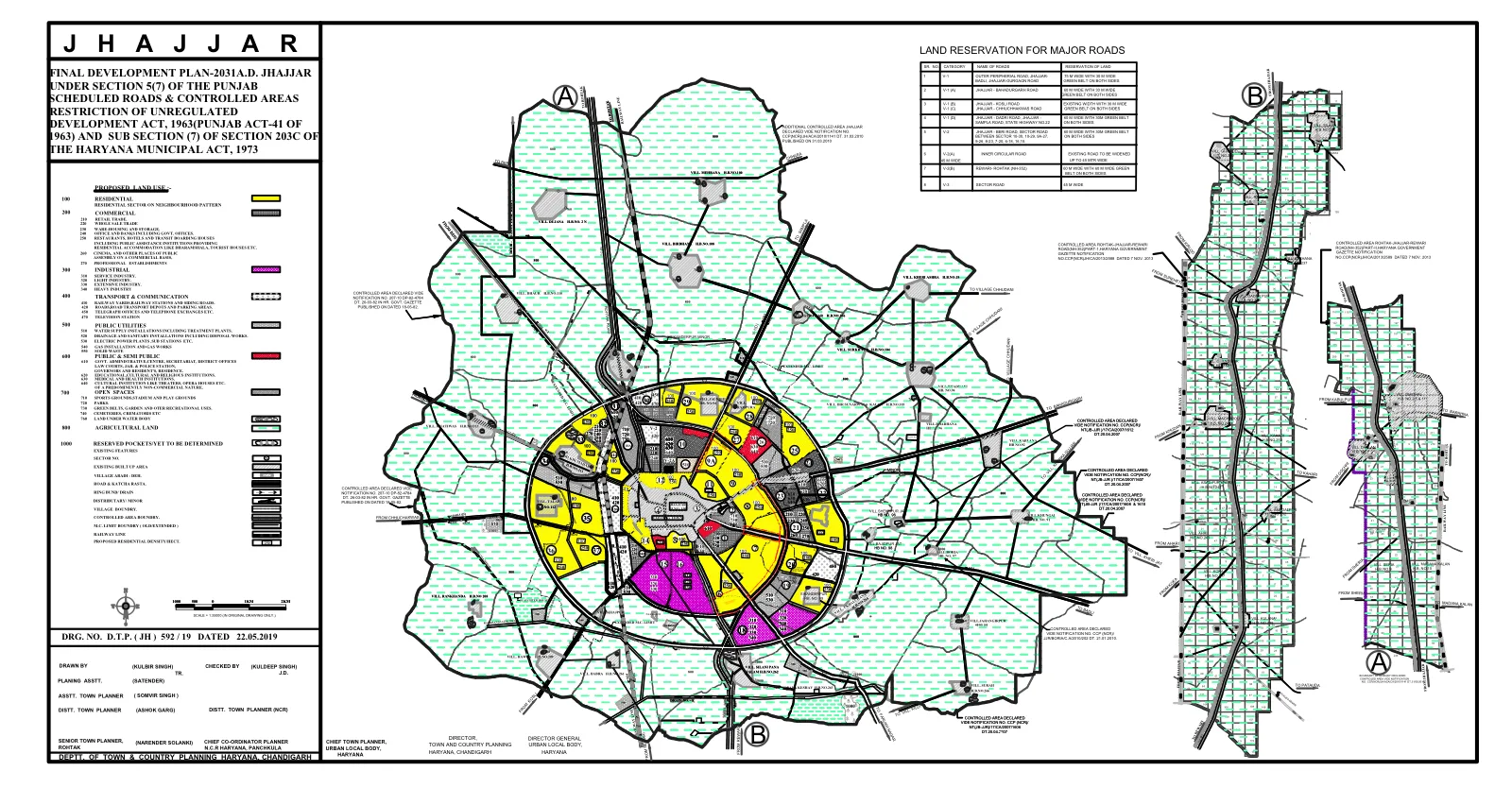
The Jhajjar Final Development Plan 2031 identifies Sector 36 within the city’s planned residential expansion. Neighbouring Sector 37 is also designated for residential development, creating the possibility of a larger, connected urban neighbourhood rather than an isolated plotted pocket.
This distinction matters.
Buying within a planned residential sector is different from buying an unregulated land parcel based only on future expectations. A formal development plan establishes the intended land use and provides a framework for roads, residential areas, public facilities, green spaces and supporting commercial activity.
It does not mean that every road or public facility shown in the plan is already complete. Master plans describe the intended direction of development; execution usually happens in phases. But they provide buyers with an official planning context against which individual projects can be evaluated.
For Sector 36, that context is one of organised residential growth alongside Jhajjar’s existing urban area.
Close to the city that already exists
Many emerging sectors depend almost entirely on future amenities. Sector 36 benefits from its relationship with Jhajjar’s established civic core.
Based on current map estimates, Jhajjar Railway Station is approximately 4.5 kilometres from the Sector 36 node, while the Mini Secretariat is around 5 kilometres away. Depending on the route and traffic conditions, both can generally be reached in approximately 10 to 15 minutes.
That proximity gives the sector a practical advantage.
The Mini Secretariat and surrounding administrative area bring district-level services, government offices and civic activity within relatively easy reach. Jhajjar’s status as a district headquarters also means the broader city already supports courts, policing, healthcare, markets and everyday services that do not need to be created from zero.
For homeowners, this matters more than a long list of distant landmarks. A future residential address becomes more usable when basic administration, transport and daily services are connected to an existing city.
Sector 36 remains a developing neighbourhood, but it is developing beside Jhajjar, not in isolation from it.
- Jhajjar Railway Station – approx. 4.5 km
- Mini Secretariat – approx. 5 km
- NH-352 – approx. 3 km
- Reliance MET City – approx. 18 km
- KMP Expressway access – approx. 20 km
- National Cancer Institute, Badsa – approx. 25 km
Distances and travel times are approximate map estimates and may vary by route, traffic and the exact project entry point.
Rail access that is available today
Jhajjar Railway Station gives the location an existing public-transport connection at a time when several larger regional projects remain under development.
The station provides regional rail access, but it should be understood for what it is: an operational railway station serving regional movement, not a metro-style urban transit system. Train frequency and convenience may not suit every daily commuter, yet the presence of functioning rail infrastructure gives Sector 36 a baseline advantage over greenfield locations that depend entirely on future connectivity.
For residents, it can support occasional and regional journeys. For the wider local economy, it offers an established transport node around which further urban activity can develop.
Future rail infrastructure may strengthen this position. The Haryana Orbital Rail Corridor is under construction and is intended to improve connectivity across major industrial nodes in Haryana. Its completion has been reported for a later phase of the decade and remains subject to execution.
The important distinction is simple: Jhajjar Railway Station exists today; the wider orbital rail benefit belongs to the future.
Roads: what works now and what is still planned
Sector 36’s current accessibility depends on Jhajjar’s existing local and regional roads, including access towards NH-352 and the functional Jhajjar–Gurugram route.
Its longer-term location story includes two more significant road developments.
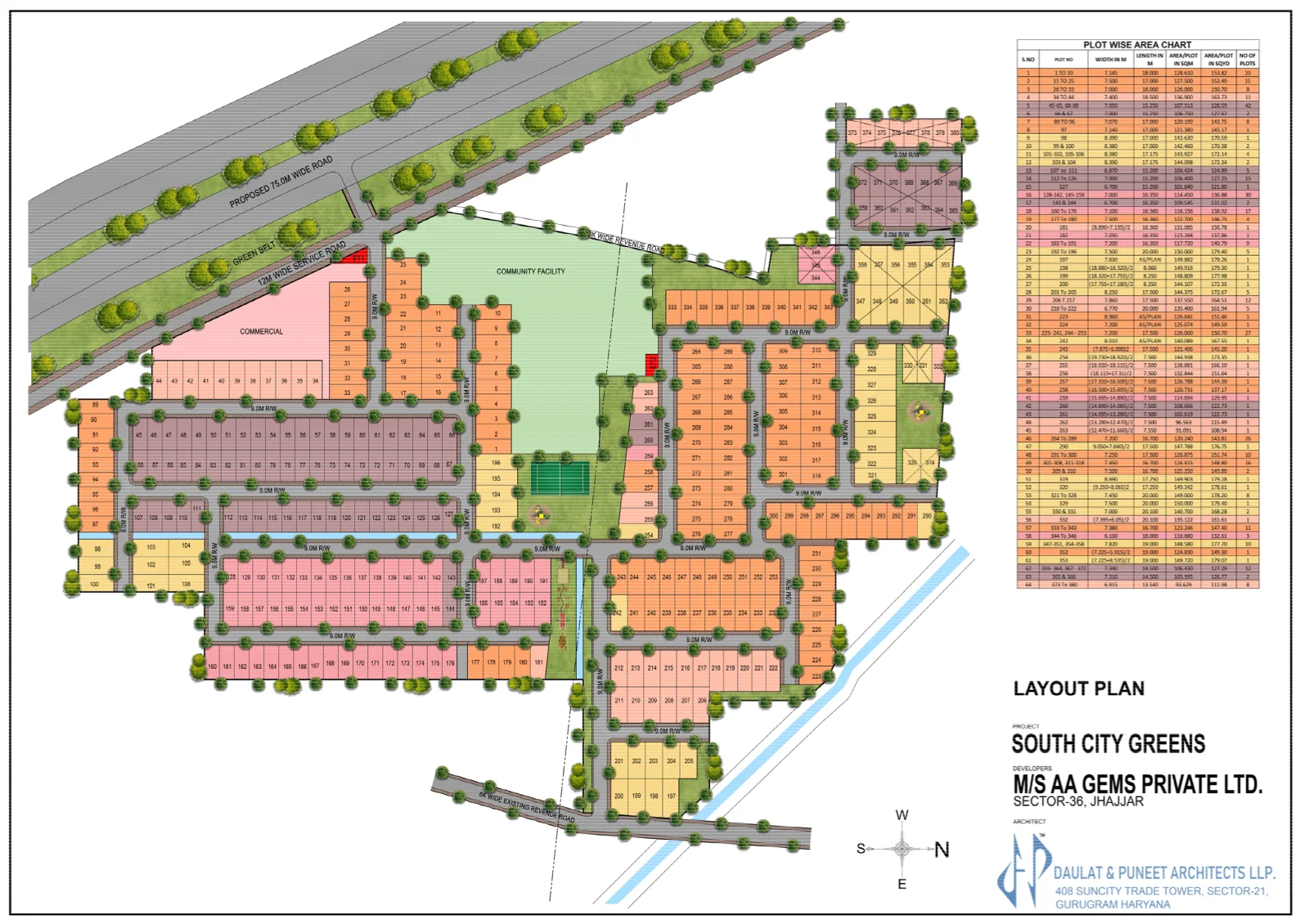
The first is the proposed 75-metre-wide road shown within the planning framework. The South City Greens layout places the development alongside this planned road alignment, separated in the layout by the designated green-belt and service-road framework.
This is an important planning advantage, but not a completed-access claim. Until the road is developed on the ground, buyers should treat it as future infrastructure.
The second is the proposed six-lane Gurugram–Jhajjar highway. Current research indicates that alignment options remain under evaluation. It is therefore incorrect to present this corridor as operational or to promise a fixed travel time to Gurugram.
If these roads are delivered as planned, they could improve regional movement and increase the number of employment centres accessible from Sector 36. Until then, the sector’s value proposition must rest on its existing access, residential planning and proximity to Jhajjar city.
An employment catchment is forming around the sector
Residential demand becomes more durable when it is connected to economic activity.
Reliance MET City is one of the strongest employment anchors in the wider Jhajjar region. Current map estimates place it approximately 18 kilometres from the Sector 36 node, although exact travel distance will depend on the destination within the township and the route used.
MET City reports a substantial multinational and industrial presence, with employment generated across manufacturing, engineering, logistics, services and supporting businesses. Not every employee will choose to live in Jhajjar, and not every job will translate into a home purchase. Some workers may commute from Gurugram, Bahadurgarh, Rohtak or surrounding towns.
Yet large employment centres generally create multiple housing requirements:
- rental accommodation for workers and junior employees;
- practical housing for technicians and supervisors;
- plotted or mid-income homes for managers and business owners;
- shops, clinics, food services and daily-needs retail;
- offices and commercial spaces serving the workforce.
Sector 36’s relevance lies in offering organised residential supply within the same wider district as this expanding employment ecosystem.
The demand case becomes stronger if projects within the sector deliver usable roads, utilities, security, green areas and community infrastructure, not merely plots on paper.
What Sector 36 can offer future homeowners
For a homeowner, the value of a plotted development is not limited to land ownership. It is the freedom to build a home suited to the family’s needs within a planned community.
Sector 36 offers several elements that can support this proposition:
- official residential land-use planning;
- proximity to Jhajjar’s established city and administration;
- operational regional rail access;
- access to existing highways and markets;
- newer plotted communities with organised internal planning;
- the possibility of independent, low-rise living;
- long-term integration with a larger residential sector framework.
At the same time, buyers should assess present liveability honestly.
Sector-level infrastructure, external roads, neighbourhood retail, schools, parks and occupancy will continue to develop over time. Families seeking an immediately mature urban environment should evaluate present ground conditions carefully. Those with a longer horizon may view the developing character of the sector as part of the opportunity.
The central homeowner question is not only, “What may come here?” It is also, “What can my family comfortably use today, and what is the realistic delivery path for the rest?”
Homeowner view
- Planned residential setting
- Near Jhajjar’s civic core
- Independent plotted living
- Community and commercial provisions
- Requires evaluation of present liveability
Long-term investor view
- Formal sector planning
- Industrial employment catchment
- Emerging road and rail catalysts
- Developing organised supply
- Requires patience and execution tolerance
What the location offers long-term investors
For investors, Sector 36 represents a developing micro-market rather than a completed residential market.
Its case is built on five layers:
Planning legitimacy: The sector forms part of Jhajjar’s official residential framework.
Proximity to an existing city: Civic and transport infrastructure is available nearby rather than being entirely dependent on future development.
Employment-led regional growth: MET City and wider industrial activity provide an economic foundation that may support housing and commercial demand.
Infrastructure potential: Planned roads and the under-construction orbital rail corridor could improve accessibility, subject to delivery.
Organised residential supply: New licensed developments can help convert an emerging location into a recognisable residential market.
These factors can support long-term interest, but they do not eliminate risk. Plotted property can require a longer holding period, resale liquidity can vary, and infrastructure delays can postpone demand. Investors should evaluate licence documentation, RERA status, project execution, title, actual road access and the level of surrounding occupancy before making a decision.
Sector 36 is better suited to a patient buyer who understands developing-location risk than to someone seeking a guaranteed short-term gain.
From South City 1 to South City Greens
The evolution of organised development within Sector 36 provides a useful reference point for how the micro-market has changed.
South City 1 entered the sector in 2022, when early project opportunities were available from approximately ₹18 lakh. In 2026, South City Greens is being introduced as a separate new plotted development in the same Sector 36 micro-market, with current opportunities beginning above ₹50 lakh.
The two prices are not a direct like-for-like comparison.
They relate to different projects launched at different times, and may involve differences in plot size, specifications, development scope, applicable charges and market conditions. The movement should therefore not be presented as the appreciation achieved by one identical plot.
What it does show is a changing entry benchmark within the same planned sector.
In 2022, Sector 36 represented an earlier-stage plotted location. By 2026, it has greater market awareness, a previous project reference, a wider industrial-growth narrative and a new development entering at a higher positioning.
For investors, this indicates that the micro-market is evolving. For homeowners, it suggests that Sector 36 is moving from an early land opportunity towards a broader residential identity.
2022 → 2026
Early Sector 36 offerings began around ₹18 lakh. New 2026 opportunities in South City Greens begin above ₹50 lakh. These figures relate to separate projects and should not be interpreted as guaranteed or uniform appreciation.
South City Greens: the next residential chapter
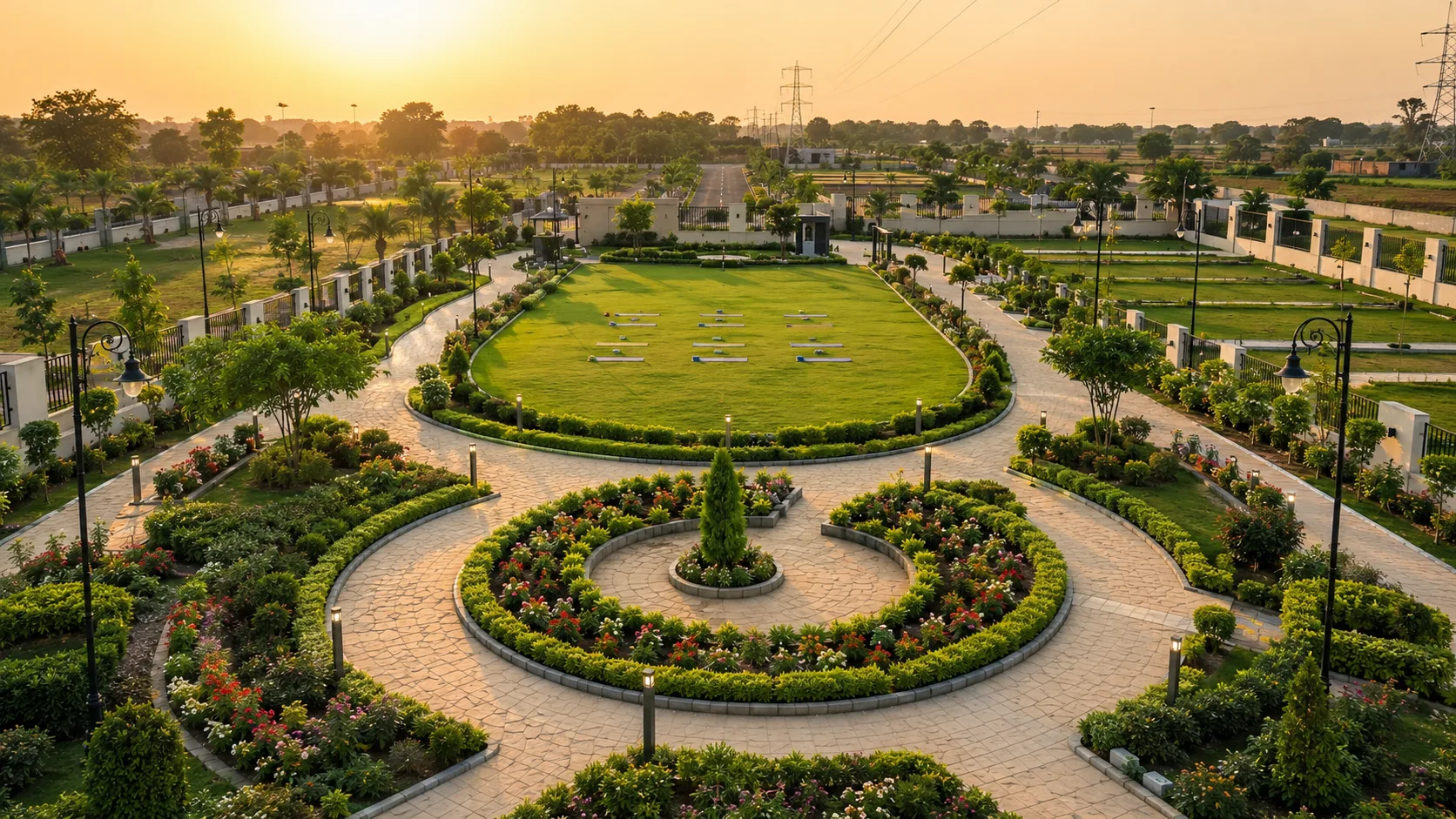
South City Greens is being introduced as a new plotted residential development within Sector 36.
The project layout presents an organised community structure with approximately 380 residential plots, internal road planning, designated green areas, a commercial component and space marked for community facilities. The plan also places the project next to the proposed 75-metre road framework.
These elements are relevant to both audiences.
For homeowners, internal commercial and community spaces can support daily convenience and neighbourhood life once developed and occupied. Green pockets and organised roads can help create a more considered residential environment than fragmented, unplanned plotting.
For investors, a development of this scale may help create a recognisable community rather than a small, isolated project. Its success, however, will depend on actual execution: roads, utilities, landscaping, security, commercial activation and sustained residential occupancy.
Current opportunities begin above ₹50 lakh, with final pricing dependent on plot size, location, availability and applicable charges.
Buyers should review the latest official project documentation, approved plans, licence details, RERA status and current development progress before committing.
An address taking shape, not a finished neighbourhood
Sector 36’s strongest quality is also the source of its greatest risk: it is still developing.
The residential planning is visible. Jhajjar’s civic and railway infrastructure already exists nearby. Industrial activity is creating a wider economic catchment. New plotted projects are adding organised supply.
At the same time, major parts of the long-term connectivity story remain dependent on public infrastructure execution. The proposed 75-metre road is not yet a finished corridor. The six-lane Gurugram highway remains a future project. The Haryana Orbital Rail Corridor is under construction rather than operational.
This makes Sector 36 neither a speculative blank canvas nor a fully matured neighbourhood.
It is an address in formation.
For future homeowners, the opportunity lies in building within a planned sector close to an established district city while the wider neighbourhood develops. For investors, the opportunity lies in a regulated residential micro-market connected to industrial growth, but one that requires patience, due diligence and a realistic understanding of infrastructure timelines.
The buyers best suited to Sector 36 are those who can distinguish between what is available today and what may arrive tomorrow.
That distinction is not a weakness in the story. It is what makes the story credible.
Buyer due diligence
Before making a property decision, independently verify:
- DTCP licence and approved layout;
- current RERA registration status;
- land title and ownership records;
- exact plot dimensions and location;
- total price and additional charges;
- current project-development status;
- on-ground access roads;
- water, power, drainage and sewerage provisions;
- status of external and master-plan roads;
- construction and possession terms;
- resale and transfer conditions.
Disclaimer
This article is intended for informational and educational purposes only. It does not constitute financial, investment or real-estate advice. Distances and travel times are approximate and may vary by route and traffic. Infrastructure projects, master plans, employment projections and development timelines are subject to approvals, changes and execution by the relevant authorities or private entities. Proposed roads and rail infrastructure should not be interpreted as currently operational. Historical project pricing does not represent direct like-for-like appreciation and does not guarantee future returns. Buyers should independently verify licences, RERA status, title documents, approved plans, pricing and current site conditions before making a financial commitment.
Related Project
South City Greens
Sector 36, Jhajjar