

Location Insight • 5 min read
Reliance MET City Explained: The Employment Anchor Behind Jhajjar's Sectors 36 and 37
A clear, sourced explainer on what Reliance MET City is, the numbers it reports, and why it anchors residential demand in Jhajjar Sectors 36 and 37, with an honest look at what jobs do and do not guarantee.
What Reliance MET City is, in plain terms
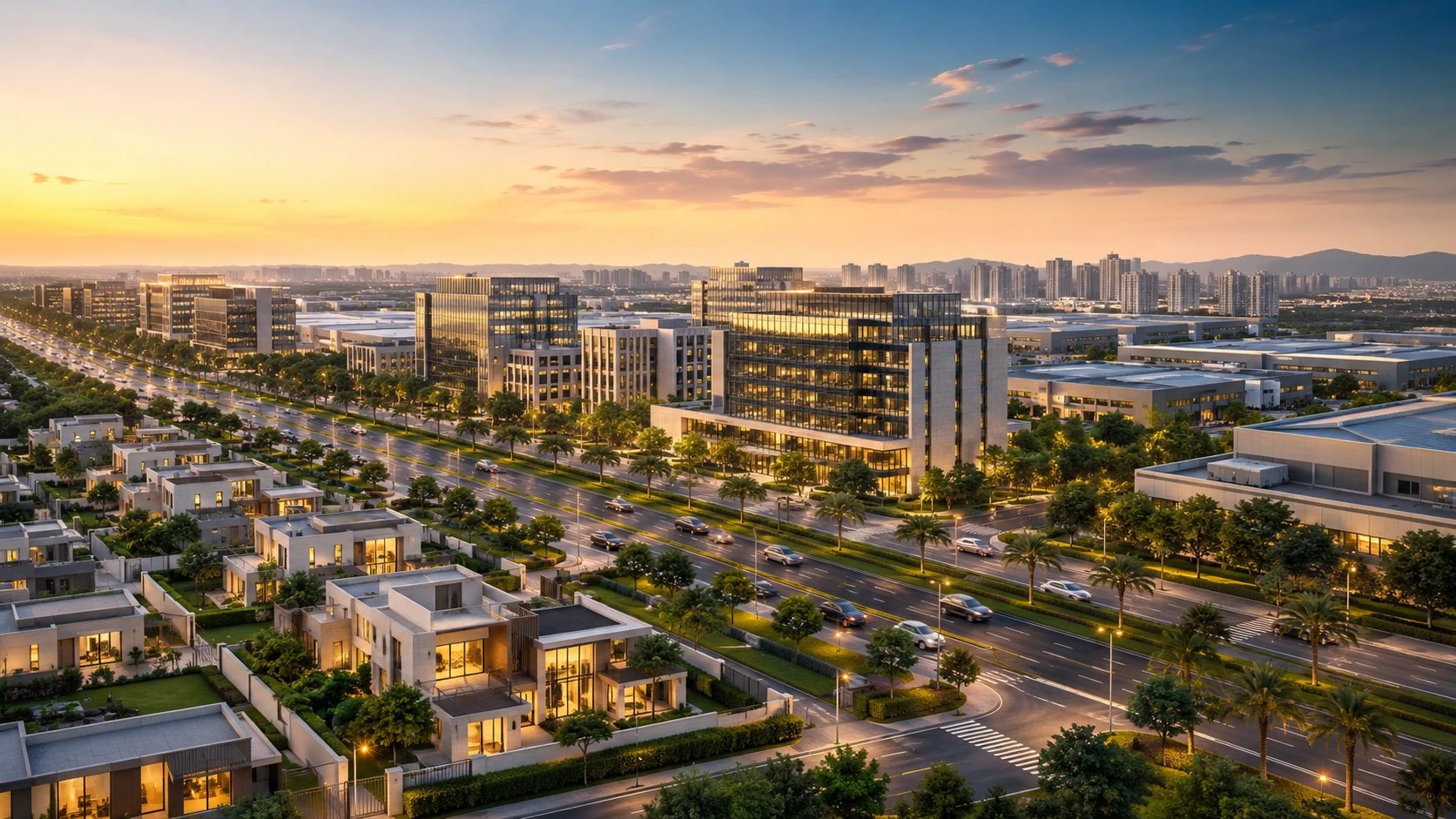
Reliance MET City is a large, integrated industrial township in Jhajjar district, Haryana, planned across approximately 8,250 acres. It groups manufacturing, business and supporting uses inside one master-planned economic zone within the National Capital Region. According to the official website metcity.in, it hosts 600+ companies from 10+ countries and supports 40,000+ jobs. In June 2026, further investment memoranda of understanding of approximately ₹8,646 crore were reported by the Economic Times.
For a plotted-land buyer in Jhajjar, that is the short answer to why MET City keeps coming up: it is the district’s employment anchor, and employment is what gives a residential market a real, everyday reason to grow. Sectors 36 and 37, designated residential in the Jhajjar Final Development Plan 2031, sit within this catchment. But an anchor is not a guarantee. Jobs nearby strengthen the case for planned housing; they do not automatically convert into home purchases, and some of the connectivity around MET City is still only proposed. This article separates what is operational today from what is proposed, so you can weigh each correctly.
MET City by the numbers
The scale is what makes MET City relevant to a residential market. An integrated industrial township of roughly 8,250 acres is not a single factory: it is a planned zone that brings together production, logistics, offices and supporting infrastructure across a range of industries. The official metcity.in figures describe 600+ companies from 10+ countries and 40,000+ jobs supported within the development.
In June 2026, the Economic Times reported investment MoUs of approximately ₹8,646 crore tied to the township. It is worth being precise about what that means. An MoU is a stated intention to invest; the associated jobs and construction follow only if the investment is implemented as planned. Existing employment reflects present-day activity. MoU-linked activity is projected. Both point to the same broad direction of travel, but they should never be presented as the same thing, and a buyer should not treat a projected number as one that already exists.
Why MET City anchors Sectors 36 and 37
Housing demand does not become durable simply because plots are for sale. It becomes durable when people have a practical reason to live in an area: jobs, services and daily life forming an ecosystem around it. MET City supplies the first and most important ingredient, a sustained and diverse employment base within the district.
Sectors 36 and 37 are designated residential in the Jhajjar Final Development Plan 2031, which gives them a formal place in the city’s planned expansion rather than positioning them as isolated land. A workforce of the scale MET City reports does not create one type of housing need. Production and contractual staff may prioritise affordable rentals; technicians and supervisors may want practical homes closer to work; engineers, managers and business owners may prefer organised plotted developments. As that mix grows, so does demand for the shops, schools, clinics and services that turn a location into a neighbourhood.
Employment is the bridge between industrial investment and housing demand. A more diverse, more established local workforce strengthens the need for homes, rentals and everyday services within a practical commute.
The honest caveat: jobs are not home sales
This is where a buyer-first reading matters most. A large employment base improves the odds for residential demand; it does not manufacture it on a schedule, and the relationship is not automatic.
Not everyone who works at MET City will buy or rent a home in Jhajjar. Many may continue to commute from Gurugram, Bahadurgarh, Rohtak, Rewari or nearby towns, especially while connectivity and civic amenities are still maturing. Conversion from “works nearby” to “lives nearby” depends on housing affordability, project execution, the delivery of roads and utilities, schools and healthcare, and whether people come to see Jhajjar as a place to live rather than only a place to work. That process is gradual and multi-year, not guaranteed.
The MoU figure deserves the same discipline. Approximately ₹8,646 crore in reported investment MoUs signals momentum, but MoUs can change in scope or timing, and the jobs and demand attached to them arrive only if and when the investment lands.
Operational today versus proposed
The most useful habit for valuing MET City’s surroundings is to separate what already functions from what is still on paper.
Operational today: the MET City industrial ecosystem itself; the Kundli-Manesar-Palwal (Western Peripheral) Expressway, which supports regional and industrial movement; Jhajjar Railway Station; existing district roads; district administration (Jhajjar is a district headquarters and was designated a Police Commissionerate in 2024); and the National Cancer Institute at Badsa, an AIIMS extension focused on oncology.
Under construction: the Haryana Orbital Rail Corridor, an electrified regional rail network, with a revised target of December 2029. Its benefits are likely but future.
Proposed: the six-lane Gurugram-Jhajjar highway, with NHAI evaluating three route alignments as of 2026, at the route-selection stage before the Detailed Project Report; and the 75-metre sector road, a master-plan provision around the residential sectors. Both are genuine proposals, not present-day connections. Any travel time that assumes them is a future estimate, not a current drive time.
How to weigh MET City in your decision
For a homeowner, MET City and the operational infrastructure around it determine how usable Jhajjar is now: an anchor employer, an expressway, a railway station, district administration and a major healthcare institution already exist. The under-construction rail corridor and the proposed highway are the upside case, best treated as patient, multi-year potential rather than a certainty.
For an investor, the fundamentals are real: a functioning industrial anchor, a reported 40,000+ jobs, and further investment commitments subject to implementation. But infrastructure can be delayed, MoUs can shift, and employment does not always convert into nearby home ownership. Buy on what exists today, and treat what is planned as a bonus rather than the basis of the purchase. Before committing, verify the specifics yourself: the project’s DTCP licence on the Haryana DTCP records, its RERA registration on the Haryana RERA (HRERA) portal (it must match the project and promoter), the approved layout, on-ground access, and the current status of any proposed road or rail before you rely on it.
Sources
The figures above are as reported by the named sources and should be verified independently. Township area, company presence and employment figures are as reported by Reliance MET City (metcity.in). The June 2026 investment MoUs of approximately ₹8,646 crore are as reported by the Economic Times. Infrastructure status draws on publicly reported information including the NCR Planning Board, the Haryana Rail Infrastructure Development Corporation and the National Highways Authority of India, with Hindustan Times / Live Hindustan (July 2026) reporting on the Gurugram-Jhajjar highway. Company figures and MoUs may change, and proposed roads and rail corridors are subject to approvals, funding and execution. Always verify DTCP licences, RERA registration, current project status and infrastructure status independently before making a decision.
Related Project
South City Greens
Sector 36, Jhajjar