

Location Insight • 6 min read
Jhajjar Infrastructure: Operational, Under Construction or Proposed
Which of Jhajjar's advantages are operational today, which are under construction, and which are still only proposed: a clear, sourced breakdown so you can value each correctly.
The single habit that protects a plotted-land buyer: separate what exists today from what is only planned
When a location is described as a “growth corridor,” the pitch usually blends three very different things into one sentence: infrastructure that is operational now, infrastructure that is being built, and infrastructure that is still only proposed. For a buyer, those three carry completely different weight.
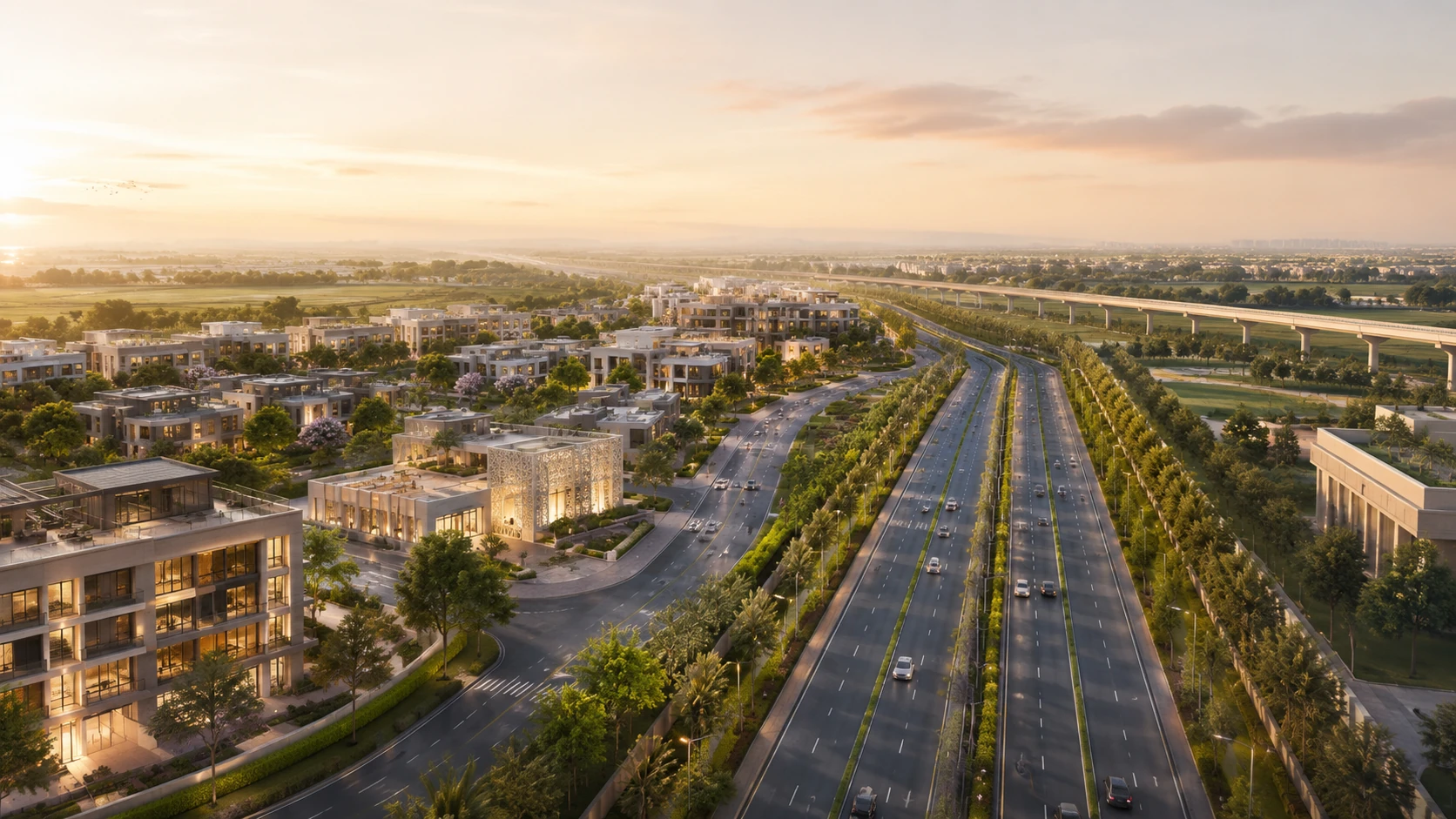
Here is the short answer for Jhajjar. Its industrial base, its main expressway, its railway station and its district administration are operational today. A major regional rail corridor is under construction. A new six-lane highway to Gurugram is still proposed and at the route-selection stage. And the wide sector road around the residential sectors is a master-plan provision. Each of those should change a buyer’s decision differently.
This article lays out that separation, with the current stage of each asset, so you can value Jhajjar for what it is rather than for what it may become.
What is operational today
These are the assets a buyer can rely on now, because they already function.
Reliance MET City is the district’s economic anchor: an integrated industrial township planned across approximately 8,250 acres, which by mid-2026 reported 600+ companies from 10+ countries and 40,000+ jobs, spanning auto components, engineering, electronics, medical devices, defence, consumer products, packaging and logistics. In June 2026, further investment MoUs worth approximately ₹8,646 crore were reported, projecting additional jobs over time. Employment is what gives a plotted market a real reason to develop, and this base exists today.
The Kundli-Manesar-Palwal (Western Peripheral) Expressway and Jhajjar Railway Station are operational and connect the district to the wider region and to Gurugram, Bahadurgarh, Rohtak and Rewari. Jhajjar also functions as a district headquarters and was designated a Police Commissionerate in 2024, which supports day-to-day administration and law and order. The National Cancer Institute at Badsa, an extension of AIIMS New Delhi, gives the district a nationally significant healthcare institution, though it is a specialised oncology centre and not a substitute for a complete local healthcare network.
What is under construction
The Haryana Orbital Rail Corridor is a roughly 126-kilometre rail network planned to connect Palwal and Sonipat through key industrial areas, intended to support regional passenger and freight movement. It is under construction, with research indicating a revised completion target of December 2029. A buyer should treat its benefits as likely-but-future, arriving over the development horizon rather than today.
What is only proposed
The six-lane Gurugram-Jhajjar highway is the connectivity most often used to shorten quoted travel times, and it is the asset that most deserves caution. As of 2026, the National Highways Authority of India was evaluating three route alignments (including greenfield options) for the corridor of roughly 33 kilometres. Reporting indicates the project is at the route-selection stage, with the Detailed Project Report to begin only after an alignment is approved. In other words, it is a genuine proposal, not an approved or under-construction road.
Any travel time that assumes this highway is a future estimate, not a current drive time. The honest question to ask about any “minutes to Gurugram” claim is simple: is that based on today’s roads, or on a road that has not yet been built?
Master-plan provisions
The 75-metre sector road (with a 30-metre green belt on both sides) planned around the residential sectors is a master-plan provision: it is marked in the development framework but is not an operational road today. It signals the intended future road hierarchy of the area, which is useful context, but it should be read as a plan, not a present-day connection.
Why the distinction matters for your decision
Existing infrastructure supports the district today. Under-construction infrastructure is likely to strengthen it over the coming years. Proposed infrastructure may or may not arrive on the expected timeline or alignment. A sound plotted-land decision values each according to its actual stage, and never prices a proposed road as if it already exists.
For a homeowner, the operational base determines how usable the area is now. For an investor, the mix of under-construction and proposed projects is the upside case, best treated as patient, multi-year potential rather than a certainty. Buy on what is real, and treat what is planned as a bonus rather than the basis of the purchase.
Sources
Figures and statuses above are drawn from publicly reported information, including the NCR Planning Board, the Haryana Rail Infrastructure Development Corporation, the National Highways Authority of India, Reliance MET City (metcity.in), and news reporting including The Economic Times (June 2026) and Hindustan Times / Live Hindustan (July 2026) on the Gurugram-Jhajjar highway. Development status varies by project and asset, and third-party figures are as reported by those sources. Always verify current project and infrastructure status independently before making a decision.
Related Project
South City Greens
Sector 36, Jhajjar