

Location Insight • 5 min read
Honest Travel Times From Jhajjar: Today's Roads vs a Proposed Highway
The widely quoted "Gurugram in about 20 to 25 minutes" and "IGI in about 40 to 55 minutes" assume a proposed highway that has not been built. Here is the honest distinction between a current drive time and a future one, and how to read any travel claim before you buy.
The short answer: those quick times assume a road that is not built yet
If you have seen Sector 36 Jhajjar marketed with “Gurugram in about 20 to 25 minutes” and “IGI Airport in about 40 to 55 minutes”, here is the honest version. Those figures assume the proposed Gurugram–Jhajjar Greenfield corridor is built. That corridor does not exist today. As of 2026 the National Highways Authority of India is evaluating three route alignments for it, and the project is at the route-selection stage, before the Detailed Project Report. So the quick times are a future estimate, not a current drive time.
Today, on the roads that actually exist (the KMP / Western Peripheral Expressway and district roads), the drive to Gurugram and to the airport takes longer than those quoted numbers. That is not a mark against Jhajjar. It is simply the difference between what is operational now and what is proposed for later. This article separates the two so you can value the location for what it is, and treat the corridor as genuine upside rather than a present-day connection.
Why the two numbers get quoted as if they are true today
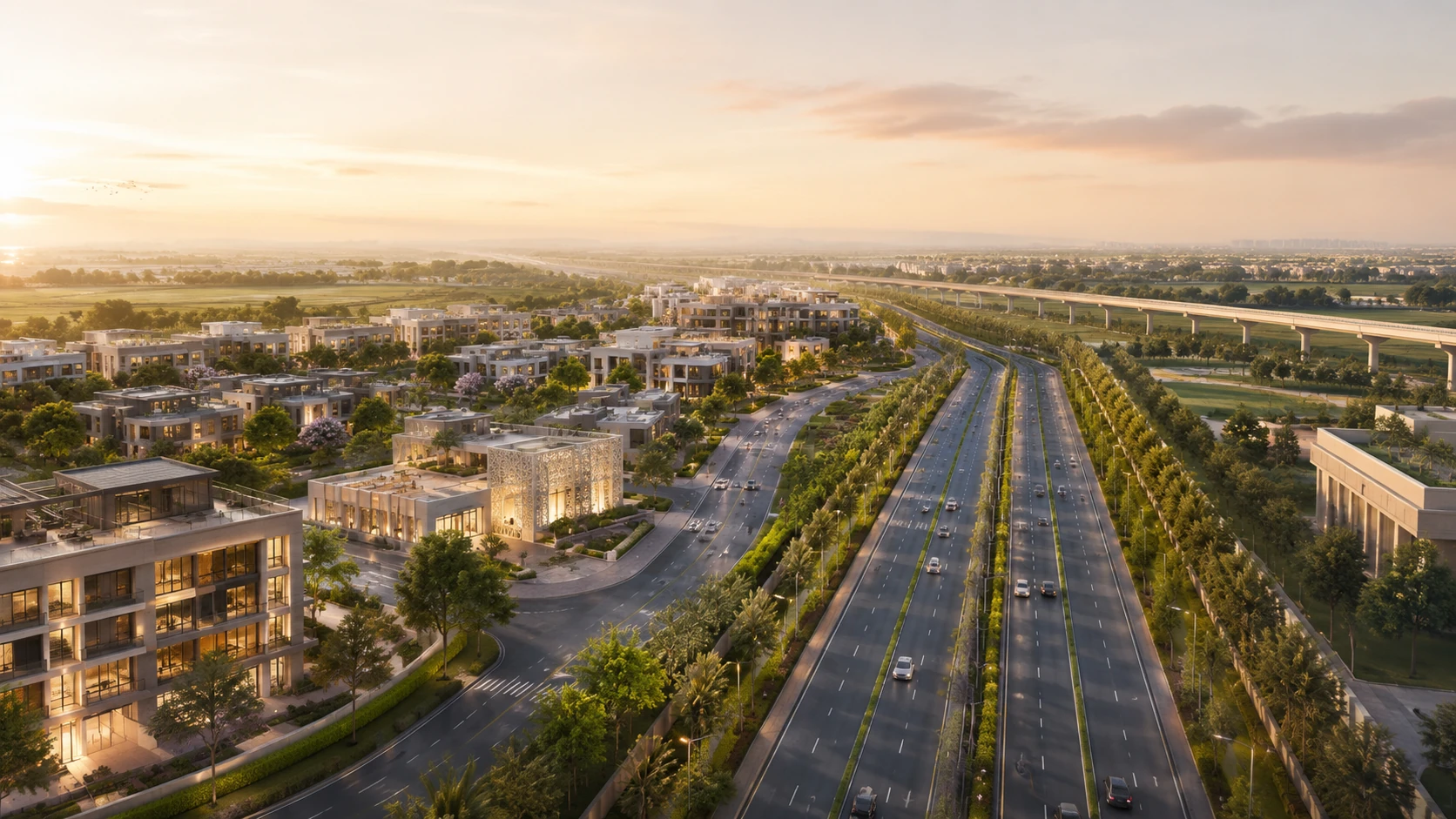
The appeal of a plotted township near an employment belt is access, so travel time becomes the headline. The problem is that a proposed road makes for a much better headline than an existing one. A future greenfield corridor, designed for speed, can plausibly bring Gurugram within about 20 to 25 minutes and IGI within about 40 to 55 minutes. Quote those numbers without the word “proposed” attached, and a reader naturally assumes they are current.
They are not. Until an alignment is approved, a DPR is prepared, land is acquired and the road is actually built, none of those minutes are available to a buyer. Treating a proposed-corridor time as today’s drive time is the single most common way plotted-land connectivity gets oversold.
What the drive is actually like today
Right now, the connection to Gurugram and the airport runs on the KMP (Western Peripheral) Expressway and district roads. These are real, operational, and they do link Jhajjar to Gurugram, Bahadurgarh, Rohtak, Rewari and the wider region. But a route built from existing expressway plus district roads is longer than a dedicated, purpose-built corridor would be. So the current drive is measurably more than the quoted figures.
The honest framing is this: Jhajjar has working regional connectivity today, and a faster dedicated link is proposed for the future. Both statements are true. Only the first one describes the drive you would make this week.
The one question to ask about any travel claim
Whenever a listing, a broker or a brochure quotes a travel time, ask a single question:
“Is that a current drive time on today’s roads, or does it assume a road that is not built yet?”
If the answer involves a proposed highway, an “upcoming” expressway, a corridor under evaluation or a master-plan road, then the time is a future estimate. It may well arrive, but you cannot drive it now, and you should not pay today as if you can. Ask the person quoting the number to separate the two, the way this developer’s material aims to: current times on existing roads, and separately, the improvement the proposed corridor would bring if and when it is built.
This habit protects you everywhere in the NCR, not just in Jhajjar. Proposed infrastructure is common across the region, and it is a legitimate part of a long-term case. It just should never be presented as the present.
How to value the proposed corridor correctly
The Gurugram–Jhajjar Greenfield corridor is a real proposal from a real authority, and if it is built on one of the alignments under evaluation, it would genuinely shorten the drive toward the quoted times. That is meaningful upside for a patient buyer. The correct way to hold it is:
- As future potential, not a present amenity.
- Dependent on alignment approval, the DPR, land acquisition and construction, each of which can shift timelines or the final route.
- As one reason the long-term direction is credible, weighed alongside what is operational now.
For a homeowner, the operational base (existing expressway, district roads, railway station, district administration, and nearby Jhajjar-city schools and hospitals) decides how usable the address is today. For an investor, the proposed corridor is part of the upside case, best treated as multi-year potential rather than a certainty. Buy on the roads that exist, and count the proposed corridor as a bonus.
The bottom line
Jhajjar’s fast-travel numbers describe a future that depends on a proposed corridor, not the drive you can make today. That does not make the numbers dishonest, but it does make them conditional, and a fair decision keeps that condition attached. Value Jhajjar on its operational connectivity now, treat the proposed corridor as upside, and carry the one question with you into every conversation: is this time current, or does it assume a road that has not been built? Then verify the current position of the corridor and today’s drive independently before you decide.
Sources
The status of the Gurugram–Jhajjar Greenfield corridor (three route alignments under evaluation, route-selection stage as of 2026, ahead of the Detailed Project Report) can be checked through the National Highways Authority of India and reporting including The Economic Times (June 2026) and Hindustan Times / Live Hindustan (July 2026). The operational status of the KMP (Western Peripheral) Expressway, district roads and Jhajjar Railway Station, and Jhajjar’s place in the NCR and the Jhajjar Final Development Plan 2031, can be verified through the relevant Haryana authorities and the NCR Planning Board. The quoted “about 20 to 25 minutes” and “about 40 to 55 minutes” figures assume the proposed corridor and are not current drive times. Development status and timelines can change, so always confirm the corridor’s current stage and today’s actual drive times independently before making a decision.
Related Project
South City Greens
Sector 36, Jhajjar